Agarwood Incense: What Is It? An Odyssey into Eastern Aesthetics and Wuxing Philosophy

The Genesis of a Scent: Agarwood Incense(沉香), What Is It?
For the uninitiated, the inquiry often begins with a simple question: agarwood incense what is it? Yet, to answer this purely from a botanical perspective would be a disservice to centuries of profound Eastern wisdom. At its most elemental, agarwood—known in Chinese as Chenxiang(沉香), or 'sinking fragrance'—is the resinous heartwood produced by the Aquilaria tree. However, in the realm of Eastern aesthetics, it is far more than a biological phenomenon. It is an artifact of nature's suffering and redemption, a tangible manifestation of time, and the highest echelon of olfactory art.
Unlike ordinary floral or woody scents that bloom effortlessly, agarwood is born of trauma. When the Aquilaria tree is wounded—by lightning, wind, insects, or the blade of an ax—it secretes a dark, dense resin to heal its scars. Over decades, or perhaps centuries, this resin coalesces with the wood, transforming into a fragrant compound of unimaginable complexity. This metamorphosis is the foundation of Chinese Xiang Dao (the Way of Incense), where fragrance is not used to mask odors, but to invite contemplation, steady the mind, and connect the mortal realm with the divine.
The Wound That Breathes: Nature's Alchemy
In classical Chinese thought, true beauty is rarely devoid of depth or history. The creation of agarwood is an alchemy born of patience. When the tree eventually falls and is buried in the damp earth or submerged in dark swamps, the un-resinated wood decays, leaving only the imperishable, resin-rich core. This resulting material is so dense that it sinks in water—hence the name Chenxiang. To understand what agarwood incense is, one must recognize it as a survivor of time, a fragrant jewel forged in the crucible of decay.
The Symphony of Wuxing: The Five Elements in Agarwood
The allure of agarwood incense is inextricably linked to the ancient Chinese philosophical framework of Wuxing, or the Five Elements: Wood, Fire, Earth, Metal, and Water. This continuous cycle of generation and restriction governs the cosmos, and intriguingly, it finds a perfect, silent articulation within the lifecycle and appreciation of agarwood.
Wood, Water, and Earth: The Root of Being
The journey naturally begins with Wood (Mu), representing vitality, growth, and the silent host—the Aquilaria tree reaching toward the heavens. It is the earthly vessel that harbors the potential for transcendence. Water (Shui) plays a dual role; it is both the lifeblood that nourishes the tree and the quiet, dark swamp that embraces the fallen timber over centuries. Water signifies wisdom, stillness, and the very test of agarwood's quality, as the finest pieces must possess enough resin to sink beneath the water's surface. Earth (Tu) is the great preserver. When the wood falls to the forest floor, it is the earth that acts as a womb. Beneath the soil, shielded from the sun, the wood undergoes a slow, silent fermentation. Earth imparts depth, grounding the ethereal scent with a profound sense of antiquity and permanence.
Gold and Fire: The Awakening of the Soul
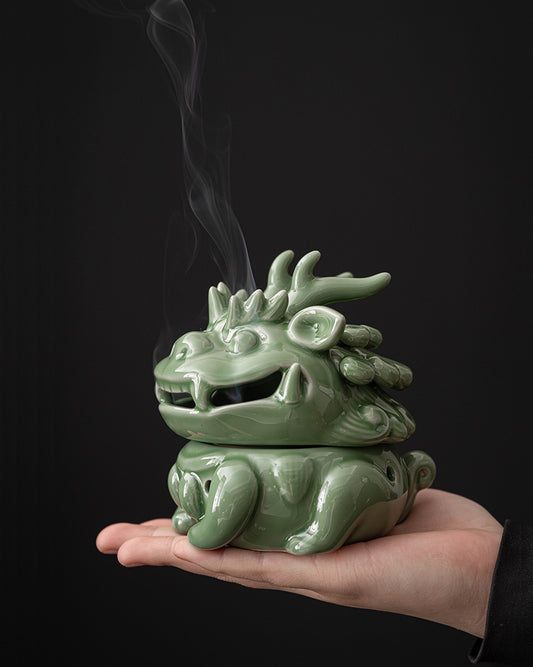
The transformation of the tree into a spiritual medium requires the intervention of Gold/Metal (Jin). Metal manifests as the lightning strike, the insect's bite, or the woodcutter's blade—the necessary catalyst of trauma that initiates the healing flow of resin. Furthermore, it is the sharp, precise tool of the incense master, delicately carving the precious wood. Finally, the cycle culminates in Fire (Huo). Fire represents illumination, spirit, and the ultimate release. In the practice of Xiang Dao, agarwood is never burned to a harsh ash. It is gently heated over a buried ember of white ash. The controlled, invisible heat of the fire liberates the dormant soul of the wood, transforming the dense resin into a wisp of ascending smoke that bridges the earthly and the celestial.
A Vessel of Time: The Literary Imagery of Chinese Fragrance
To experience agarwood is to step into a classical Chinese painting, a realm of ink washes, solitary pines, and mist-shrouded peaks. Throughout Chinese dynastic history, agarwood was the quiet companion of poets, scholars, and emperors. The Song Dynasty literati, such as the renowned poet Su Shi and the calligrapher Huang Tingjian, elevated the appreciation of incense to an essential scholarly pursuit, placing it alongside the tasting of tea, the hanging of paintings, and the arranging of flowers.
Silent Poetry in the Scholar's Studio
Classical Chinese literature is imbued with the imagery of lingering incense. It is described as a 'silent poetry,' an invisible architecture that structures the quietude of a scholar's studio. When the incense master prepares a session, the solitary wisp of smoke rising from the censer is likened to a crane ascending into the clouds, or a solitary monk walking a mountain path. The scent is often described not merely in terms of its aromatic profile—which ranges from sweet honey and cooling mint to damp earth and ancient libraries—but by its energy. A premium agarwood incense does not assault the senses; it enters the room with the measured grace of an honored guest. It possesses a cold, austere elegance, a characteristic highly prized in Eastern aesthetics, reminding the host of moonlight reflecting off frost.
Beyond Consumption: Agarwood as a Spiritual Heritage
In a modern world obsessed with instant gratification and overwhelming sensory inputs, understanding agarwood incense requires a shift in paradigm. It is absolutely not a room freshener, nor is it a mere commodity to be consumed and forgotten. Genuine agarwood is a finite, deeply revered treasure. It is a high-tier cultural carrier, bearing the weight of philosophy, history, and spiritual devotion.
The Art of Collection and Contemplation
To possess a piece of fine agarwood, whether in its raw sculptural form or meticulously crafted into incense sticks, is to curate a fragment of time. It is an act of collection that transcends material wealth, entering the domain of spiritual investment. The value of agarwood lies in its profound scarcity and the unrepeatable conditions of its creation. When you light a piece of authentic agarwood incense, you are participating in a ritual that has remained unchanged for millennia. You are inhaling the resilience of the wood, the depth of the earth, the memory of the water, the precision of the metal, and the liberation of the fire. It is an invitation to slow down, to turn inward, and to discover the vast, silent universe that exists within a single, elegant breath.