Incense and Peppermints: How a 1967 Psychedelic Anthem Understood Scent Rituals

There is a song that has haunted the edges of memory since 1967.
Incense and peppermints, the color of time — the opening line of Strawberry Alarm Clock's era-defining hit drifts through the decades like smoke through still morning air. It reached Number One on the Billboard charts that November, becoming the accidental anthem of a generation that was, in its own chaotic way, searching for the same thing every generation searches for: a way to feel present in an increasingly noisy world.
We think about that song often here at Bifang Studio(bifangstudio.com). Not because we are nostalgic for the Summer of Love — but because incense and peppermints, as a pairing of sensory anchors, understood something that neuroscience would only confirm much later. Scent is the only sense with a direct pathway to the limbic system — the brain's seat of emotion and memory. To burn incense is not mere decoration. It is a deliberate act of consciousness.
The Song They Almost Never Released
The story behind "Incense and Peppermints" is as unlikely as the song itself. It began as a wordless instrumental written by keyboardist Mark Weitz and guitarist Ed King for a California cover band called Thee Sixpence. When the band needed lyrics, their manager brought in outside writers — and the result was a title so evocatively strange it became a cultural touchstone.
The song was initially planned as the B-side of a single. A DJ flipped the record, and what was meant to be an afterthought soared to Number One.
An afterthought that became everything. There is a lesson in that, somewhere — about the things we almost overlook, the quiet rituals we almost skip, the single stick of incense we almost don't light because the morning is already too full.
What the Song Was Really About
At its core, "Incense and Peppermints" has been interpreted as an anthem of non-conformity and youthful irreverence — a call to cognitive awakening, demanding that listeners become active participants in their own psychosocial experience.
Turn on, tune in, turn your eyes around.
Strip away the psychedelia, and what remains is a remarkably timeless instruction: pay attention. Look inward. Do not sleepwalk through your own life.
This is, quietly, the same invitation that has been extended by incense rituals for thousands of years — from the Song Dynasty scholars who burned xiang to mark the hours of contemplation, to the Japanese kōdō masters who trained for years to identify a single wood by its smoke alone. Incense was never merely fragrance. It was a technology of presence.

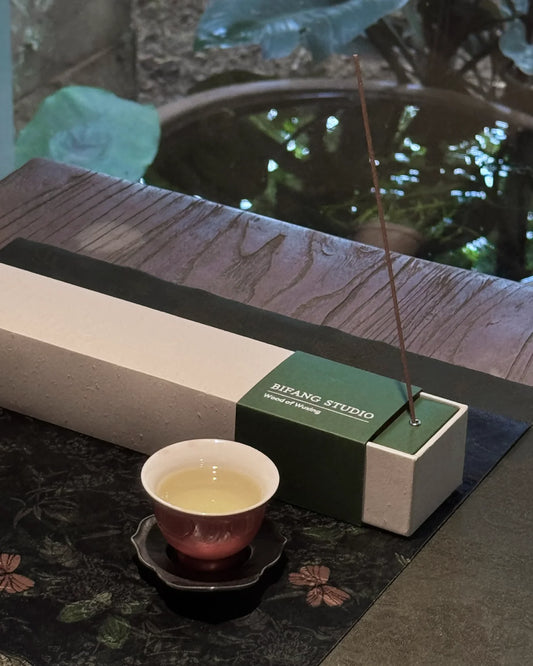
An Oriental ritual of scent, where incense meets tea.
The Scent of Time
The lyric "incense and peppermints, the color of time" functions as a synesthetic metaphor — combining the sensory and the temporal, painting an image of a period as vibrant and layered as the senses themselves.

Time has a color, if you know how to look. It has a scent, too.
The particular quality of early morning light — that pale gold that exists for only minutes before the world becomes ordinary again — has a corresponding smell. Something cool and resinous. Something that asks nothing of you except that you be still.
At Bifang Studio, every piece we create is designed to inhabit that moment. Our incense is not a product for busy hands. It is an object for quiet ones. A single stick, a curl of smoke, and suddenly the morning has a shape it did not have before.
From Counterculture to Slow Culture
The generation that fell in love with incense and peppermints was, in its way, the first modern generation to loudly reject the acceleration of ordinary life. They burned incense in their apartments not just to mask the smell of rebellion, but because something in the ritual — the flame, the smoke, the slow dissolution of something solid into air — told the nervous system to soften.
We are living through a second such moment.
The #SlowMorningRoutine is not nostalgia. It is a sober response to a world that has grown so loud it has begun to harm us. The screen-free morning, the analog ritual, the deliberate choice to begin the day with the hands rather than the feed — these are acts of quiet resistance that would have been immediately recognizable to anyone who heard that song in 1967 and felt, inexplicably, understood.

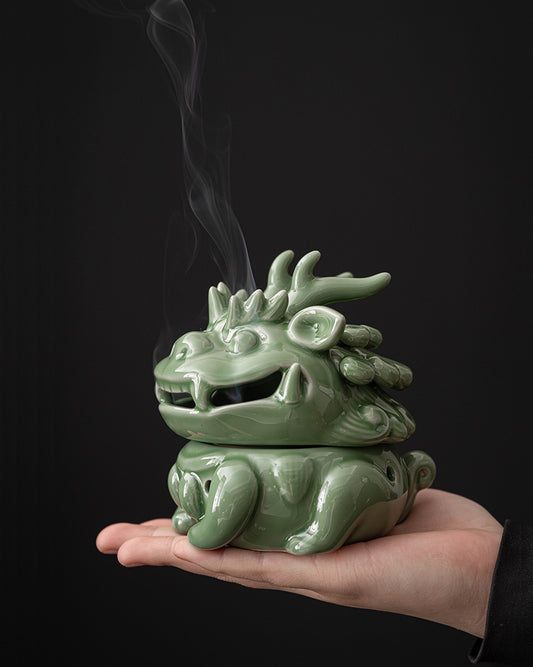
A healing morning ritual using Chinese incense.
On Peppermints
The peppermint half of the equation deserves a moment, too.
Peppermint — sharp, clarifying, instantly awakening — has been used in ritual contexts across cultures for centuries. Where incense softens and expands, peppermint focuses and clears. Together, they describe a complete sensory grammar for the beginning of a day: first the warmth and depth of smoke, then the cool clarity that follows.
A morning ritual, at its most essential, is exactly this movement. From the haze of sleep into the crisp intention of wakefulness. From Yin into Yang, as the ancient Chinese philosophers described the transition of dawn.
The Strawberry Alarm Clock may not have known they were encoding a philosophy. But the best songs rarely know what they contain.

Chinese Peppermint Incense-Edition For Relief & Relaxation
An Invitation
If you have never built a morning ritual around incense, we would like to offer you one small beginning.
Before you reach for your phone tomorrow morning — before the notifications, the headlines, the accumulated weight of everyone else's urgency — light a single stick. Watch the smoke. Breathe. Let the first color of your day be something you chose.
Incense and peppermints, the color of time.
They knew, in 1967, that time has a color. We are still learning to see it.
Explore Bifang Studio's collection of premium incense and slow morning objects at bifangstudio.com
Tags: incense and peppermints, incense and peppermints song, slow morning routine, premium incense, incense ritual, mindfulness, screen-free morning, Bifang Studio