Whispers of the Dao: The Art and Philosophy of the Ceramic Backflow Incense Holder

The Poetry of Descending Mist
In the profound stillness of an Eastern study, time is not measured by the rigid ticking of a clock, but by the quiet, graceful descent of fragrant smoke. It is within this serene atmosphere that the backflow incense holder ceramic reveals its true essence. Far removed from the fleeting trends of modern decor, this exquisite vessel serves as a profound conduit between the physical realm and the spiritual world. It is a miniature landscape, a silent poem crafted from earth and ash, designed to guide the modern soul back to a state of primordial tranquility.
To understand the gravity and beauty of the ceramic backflow incense holder, one must peer through the lens of ancient Chinese philosophy, specifically the concept of Wuxing, or the Five Elements. This classical framework—comprising Wood, Fire, Earth, Metal, and Water—is not merely an abstract theory, but a living, breathing symphony that orchestrates the universe. A masterfully crafted incense vessel is the physical manifestation of this cosmic balance, bringing the profound harmony of the natural world directly into your private sanctuary.
Earth and Fire: The Alchemy of Form
The genesis of every backflow incense holder ceramic is rooted deeply in the element of Earth (Tu). Clay, harvested from the ancient veins of revered mountains, carries the heavy, grounding energy of the world. It is patient, yielding, and imbued with the silent memories of millennia. The artisan, acting as a humble servant to nature, shapes this raw earth with mindful intention, coaxing out forms that echo towering cliffs, gentle lotus petals, or the stark, minimalist lines of a Zen pebble.

The Kiln's Trial: Crafting Permanence
Yet, form alone is incomplete without the transformative trial of Fire (Huo). Placed within the roaring heart of the kiln, the fragile earth undergoes a profound alchemy. The fire purifies and solidifies, binding the minerals into a state of elegant permanence. The resulting ceramic surface—whether dressed in a crackled Ru-ware glaze that mirrors the misty rain of Jiangnan, or left as porous, unglazed Zisha stoneware that invites the touch—speaks of a refined restraint. This delicate interplay of Earth and Fire creates an artifact of enduring legacy, a collectible piece of art that withstands the erosion of time while anchoring the space it inhabits.

Wood and Water: The Architecture of Scent
The soul of the ritual naturally belongs to the element of Wood (Mu). The incense cone itself is a concentrated offering of nature, crafted from the precious heartwood of agarwood, sandalwood, or ancient cypress. It is the life force of the deep forest, naturally dried and distilled into a dormant state, awaiting the spark of life. When ignited, the Wood yields its spirit, releasing a fragrance that is simultaneously ancient and entirely present, bridging the gap between the earthly and the divine.
Herein lies the unique visual genius of the backflow incense holder ceramic. Through a masterstroke of design, the ethereal smoke—which normally seeks the heavens—is inverted, manifesting the nature of Water (Shui). In classical Eastern thought, particularly within the teachings of Laozi, water is the ultimate symbol of wisdom and the Dao. It is soft, yielding, yet powerful enough to carve through stone. It flows downward, remaining humble, seeking the low places, thereby drawing closer to truth.
The Liubai of Smoke: Painting with Mist
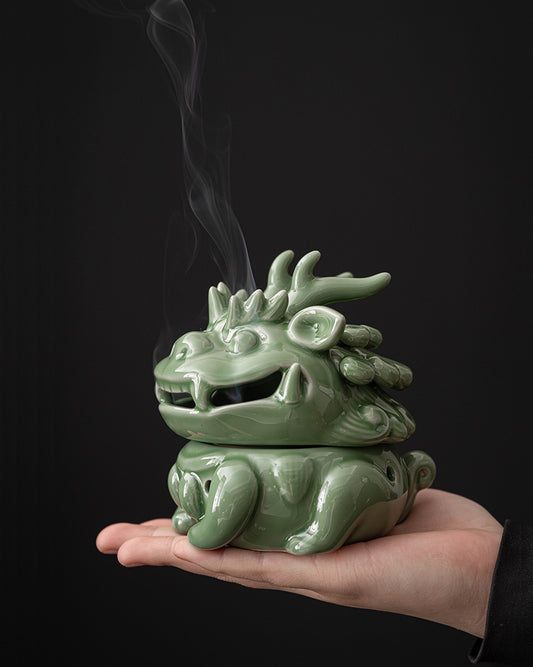
As the heavy, resin-rich smoke cascades down the tiers of the ceramic holder, it pools into the subtle crevices like a silent, milky river. It creates a breathtaking illusion of a misty waterfall captured in an eternal sigh. To watch this silent stream is to witness a visual representation of a Tang Dynasty poem by Wang Wei, where clouds rise from the valleys and clear springs flow over white stones. The descending smoke becomes the negative space—the Liubai—of a traditional ink wash painting, offering the mind an empty, boundless canvas upon which to rest.

Metal: The Invisible Boundary of Mindfulness
One might wonder where the element of Metal (Jin) resides within this earthy, fluid tableau. Metal represents structure, precision, clarity, and the unseen laws of equilibrium. In the context of the backflow incense holder ceramic, Metal is the invisible architecture within. It is the meticulously calculated, hidden channel within the clay, the exact proportion of the airway that allows the physics of the smoke to operate with unbroken, descending grace.
Furthermore, within the framework of traditional Chinese medicine and philosophy, Metal governs the breath. As you sit before the cascading mist, your respiration naturally slows, aligning with the rhythm of the incense. The unseen metal element provides the discipline of mindfulness, the sharp clarity that cuts through the fog of daily anxieties. It invites you to inhale the pure essence of the wood and exhale the accumulated tension of a cluttered, modern existence.
Beyond Decoration: Cultivating Your Sanctuary
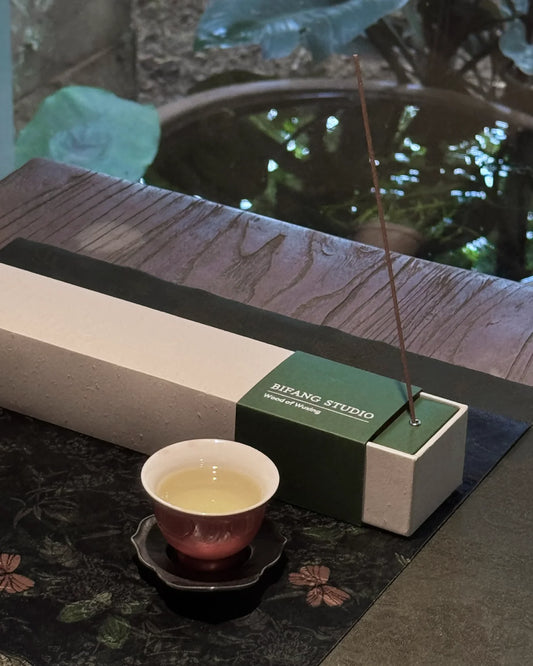
To introduce a backflow incense holder ceramic into your living space is a deliberate act of cultural curation and spiritual grounding. It is not a mere transaction, but the acquisition of an heirloom. In the realm of Xiangdao—the Way of Incense—every object commands respect and fosters introspection. When placed upon a carved wooden scholar's desk, beside a weathered bonsai or a cup of pale green tea, the ceramic holder silently anchors the room. It transforms an ordinary corner into an altar of inner stillness.
We reside in an era characterized by relentless speed and perpetual noise. The ceramic backflow incense holder offers a profound antidote. It demands nothing but a moment of pause. Lighting the cone, waiting for the first wisp of white smoke to crest the lip of the ceramic basin, and following its slow journey downward is a ritual of profound detachment. It teaches the quiet art of letting go, reminding us that there is majestic beauty in yielding, in flowing downwards, in embracing the quiet shadows of our inner landscape.
In the presence of such an artifact, one does not simply smell a pleasant aroma; one engages in a silent dialogue with antiquity. The backflow incense holder ceramic stands as a testament to the enduring power of Eastern aesthetics—a sophisticated fusion of natural elements, profound philosophy, and masterful craftsmanship. It is an invitation to elevate your daily existence, to dwell poetically in the world, and to discover boundless eternity within a single, descending breath of fragrant mist.