The Descent of Clouds: How Does Backflow Incense Work Within Eastern Philosophy

In the quietude of a traditional Chinese studio, time does not tick; it flows. It drifts like the mist over the ancient peaks of Huangshan, moving with a deliberate, unhurried grace. Central to this atmosphere of profound stillness is the art of Xiang Dao, or the Way of Incense. Among the myriad expressions of this ancient practice, few are as visually captivating and philosophically resonant as the backflow incense burner. Observing the heavy, milk-like plume of fragrant smoke cascade downward like a silent waterfall invites a natural curiosity: how does backflow incense work? The answer is a delicate interplay of earthly physics and transcendent Eastern philosophy.
The Architecture of Serenity: The Mechanics of the Cone
To understand how does backflow incense work, one must first examine the careful architecture of the incense cone itself. Traditional incense releases a warm plume of smoke that rises, carried upward by the thermal energy of the ember. The backflow incense cone, however, harbors a deliberate secret: a hollow channel carved directly through its vertical axis, with a small opening at the base.
When the tip of the cone is ignited, the heat initially forces a wisp of smoke upward. Yet, as the ember burns down toward the hollow core, the dynamic shifts. The smoke is drawn into this narrow, unlit channel. Isolated from the ambient air, the smoke cools rapidly as it travels downward. Because cool air is denser and heavier than warm air, the smoke gathers weight. By the time it exits the aperture at the bottom of the cone, it possesses the physical properties of a liquid mist. Gravity takes hold, guiding the dense, fragrant vapor down the intricate ledges of the ceramic censer. It is an elegant manipulation of thermodynamics, engineered to create an atmosphere of immediate tranquility.
The Wuxing Philosophy Within the Waterfall of Smoke

In traditional Eastern aesthetics, no physical phenomenon exists in isolation. The mechanics of the descending smoke are merely the visible expression of deeper cosmic principles, most notably the Wuxing (Five Elements) philosophy. The backflow incense ritual is a masterful curation of Wood, Fire, Earth, Metal, and Water, seeking harmony in their continuous cycle of transmutation.
Wood (木): The Origin of Fragrance
The foundation of the incense is Wood. We speak not of generic sawdust, but of noble materials: aged agarwood (Chenxiang) or matured sandalwood (Laoshan Tan). These woods have endured decades, sometimes centuries, of silent growth and natural decay in deep forests. They absorb the essence of the sun and the damp earth, storing a profound olfactory memory. In the backflow cone, Wood represents the origin of life and the inherent potential waiting to be released.
Fire (火): The Catalyst of Transformation
Fire is the catalyst. It is the single spark of Yang energy introduced into the dormant Yin of the wood. In Eastern philosophy, Fire is the element of transformation and clarity. It consumes the physical form of the incense, acting as a bridge between the tangible world and the ethereal realm. The disciplined ember atop the backflow cone does not rage; it glows with a restrained intensity, slowly liberating the soul of the wood.
Earth (土): The Grounding Vessel
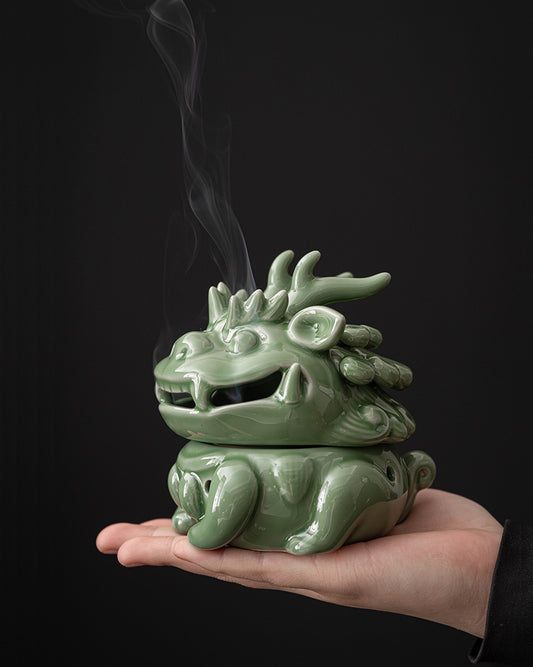
The descending smoke must have a landscape to traverse, and this is provided by Earth. The censer, typically crafted from dark Yixing clay, porcelain, or stoneware, is born of the soil. Fired in kilns, these vessels are not mere accessories; they are miniature, sculptural representations of classical Shan Shui (mountain and water) landscapes. A high-end backflow burner is a collectible piece of art, offering a grounded, stabilizing energy that holds the fluid motion of the smoke.
Gold/Metal (金): The Gravity of Autumn
Metal, in the Wuxing system, is associated with the season of autumn, characterized by descent, condensation, and inward movement. The very physics that answer how does backflow incense work—the cooling and condensing of the smoke—is a manifestation of the Metal element. The smoke, heavy and dense, mirrors the sinking, gathering energy of late autumn mist settling into a valley.
Water (水): The Formless Flow
Though entirely dry, the visual manifestation of the cooled smoke is Water. It flows, pools, and cascades, entirely yielding to the shape of the Earth vessel beneath it. Laozi wrote in the Dao De Jing that the highest excellence is like water, benefiting all things without striving. The descending smoke perfectly captures this silent, effortless flow, washing over the mind of the observer and drawing them into a state of deep contemplation.
Classical Imagery and the Art of Collection
The allure of backflow incense extends far beyond its pleasant aroma. It is a physical embodiment of classical Chinese literature and poetry. When watching the heavy smoke settle into the basin of a dark ceramic lotus or a miniature mountain gorge, one is reminded of the Tang dynasty poet Wang Wei, who wrote of empty mountains following autumn rain, where the pine winds and the murmuring brooks converse in silence. The incense burner becomes a vessel of spiritual transport, allowing the modern individual to briefly inhabit the quietude of a hermit's mountain pavilion.
For the discerning collector, acquiring a masterfully crafted backflow censer and premium incense cones is an investment in personal cultivation. These are not ephemeral consumer goods. A beautifully sculpted censer, paired with cones blended from pure, unadulterated botanical resins, serves as a lifelong companion in the pursuit of mindfulness. The ritual demands attention and respect; the air in the room must be completely still, free from drafts, forcing the practitioner to slow their own movements and, consequently, their breath.

A Return to Stillness
Understanding how does backflow incense work is to appreciate the convergence of natural law and human intention. It is a reminder that beauty often relies on structure, and that profound peace can be engineered through subtle shifts in our environment. The descending fragrant cloud does not shout for attention. Instead, it offers a silent invitation to pause, to observe the graceful weight of the intangible, and to reconnect with the timeless elegance of the Eastern philosophical tradition. In a world defined by its relentless upward striving, the backflow incense gently teaches us the profound, restorative power of letting go and allowing things to settle.