Trinket Shelf Ideas: How to Display Meaningful Objects
Collected objects · Everyday interiors
The small things are often the hardest to arrange: a ceramic animal, a stone from a walk, a postcard you kept. A trinket shelf gives them a place in the room, with enough space for each one to be noticed.

Start with one main object, add a smaller group beside it, and leave a visible stretch of shelf empty. That simple arrangement is a useful starting point for a collection that has grown through living, rather than being bought all at once.
Begin with a small edit of your collection
Clear one shelf completely. Keep the rest of the room as it is, so you can see what this particular surface needs. Measure its usable depth, including any lip or wall bracket, before choosing objects to put back.
Pick one piece you want to see from the doorway. It could be the tallest object, the strongest color or simply the one with the clearest outline. Give it a position first. Then choose two or three companions with a connection: a shared tone, a place you visited or a material you enjoy touching.
Put the remaining pieces aside for another shelf or a later rotation. A good edit makes the objects you have chosen easier to see. If everything has equal visual weight, a favorite piece can disappear into the collection.
A useful first arrangement: one main object, one low group and one clear gap. Treat it as a starting point, then adjust it to your shelf and the pieces you own.
Three trinket shelf layouts to try
1. A book-led shelf for mixed personal finds
Place a short row of upright books toward one end, using a proper bookend if needed. Beside them, lay two substantial books flat and put one lightweight, stable object on top. Finish with a smaller object directly on the shelf, leaving a gap between the two groups.
The books give tiny pieces a different height and a readable background. Keep their titles accessible; this is still a bookshelf. Avoid balancing a heavy ceramic on a small or flexible book stack, and check that the arrangement respects the shelf's load rating.

2. A simple ledge for three favorite objects
For a shallow ledge, choose pieces that fit fully within its depth. Place the largest slightly off-center, then make a loose pair from the two smaller pieces. Keep a visible gap between the single object and the pair instead of distributing all three at equal intervals.
A standing postcard can provide a taller background if it is securely supported. Let the object in front overlap a little of the card, while keeping the detail you care about visible. Keep fragile pieces away from the edge.

3. A collection shelf with one open bay
If you collect similar objects, arrange a few together so their differences become the point. Group three small ceramics at one end and place a taller piece at the other. Leave the middle open, or reserve it for a single low bowl.
On a bookcase with several compartments, keep one bay lighter than the others. The empty area helps the fuller sections feel intentional. You can display a generous collection without filling every compartment to the same density.

Repeat a color, then vary the surfaces
When the arrangement feels scattered, look for one color already present in two pieces. Bring those objects closer together, or repeat that color elsewhere on the shelf with a book spine or small print.
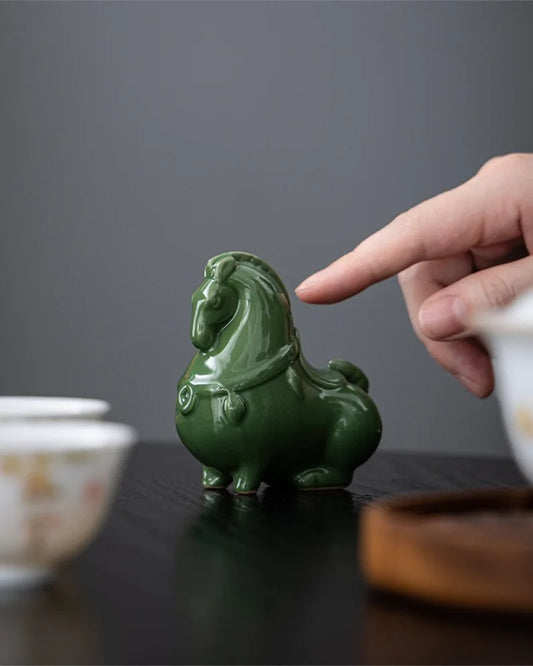
The materials can still differ. A green glazed ceramic, ceramic teacups and a bamboo tray share a gentle palette while giving the eye different surfaces to explore. With a stronger accent, such as a Red Ceramic Horse Figurine, let nearby pieces stay simpler so its outline remains clear.
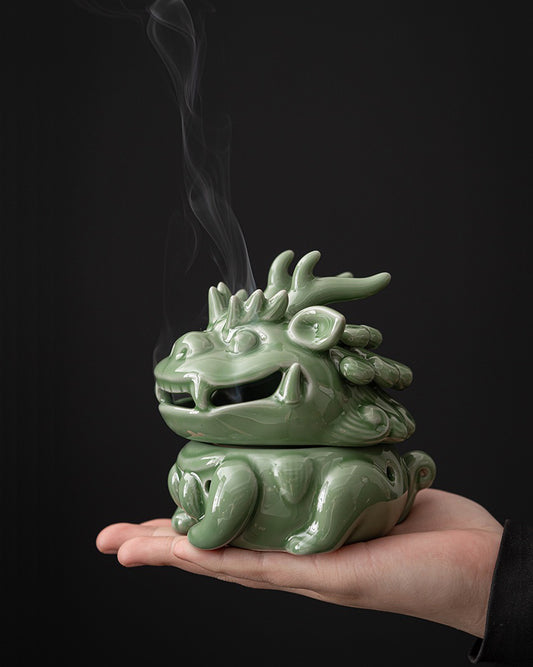
The Celadon Dragon Incense Burner can sit among collected objects as an unlit ceramic sculpture. Its rounded form offers a different shape beside straight book spines. If you use it for incense, move it to an appropriate open, heat-resistant surface, following its care instructions.

Adjust the shelf from where you actually see it
Stand in the doorway, then sit in your usual chair. An arrangement that works close up may disappear from across the room. Turn one object slightly or move it away from a busy background before deciding that the shelf needs another purchase.
| What you notice | What to change |
|---|---|
| Every piece seems equally important. | Choose one main object and give it a larger gap on one side. |
| Small objects disappear. | Group them together or raise one on a stable book stack. |
| The shelf feels busy. | Remove one competing color or move a group to another shelf. |
| The arrangement feels too formal. | Shift one group off-center and vary the spaces between pieces. |
Check ordinary use as well. Can you remove a book without lifting three other things? Can you dust around the ceramics? Leave room for those movements. A display that is easy to live with is more likely to keep its shape.
A few questions about displaying small collections
How many objects should go on a trinket shelf?
There is no fixed number. Begin with three to five pieces on one section of shelf, then assess their size and spacing. Several tiny objects may read as one group; a large ceramic may need most of the surface to itself.
Can different styles belong on the same shelf?
Yes. Give them one point of connection, such as color, material or a shared personal story. Keep their outlines visible instead of trying to make every piece match.
What if I want to display everything?
Divide the collection into small groups across several shelves, or rotate a few pieces when you clean. Photograph arrangements you like so favorite combinations are easy to bring back.