The Way of Fragrance: An Initiation into Xiangdao and the Incense Tao

To ask what is Xiangdao incense tao is to inquire about the very breath of antiquity. In the contemporary world, fragrance is often reduced to a mere accessory, a fleeting sensory distraction. Yet, within the profound depths of traditional Eastern aesthetics, scent is not an addition to life; it is a discipline, a philosophy, and a bridge to the eternal. Xiangdao, translated directly as the "Way of Fragrance" or the "Incense Tao," represents the pinnacle of Chinese olfactory culture. It is an intricate ritual of preparing, appreciating, and meditating upon rare aromatic woods, while paying close attention to the subtle movement of incense smoke and fragrance.
The Essence of Xiangdao: Beyond the Olfactory
Originating millennia ago and reaching its cultural zenith during the Tang and Song dynasties, Xiangdao was revered as one of the "Four Arts of the Chinese Scholar," alongside brewing tea, arranging flowers, and appreciating hanging scrolls. For the literati, philosophers, and nobility of ancient China, the incense ceremony was a sanctuary from the mundane world. It was an intellectual and spiritual pursuit where a single curl of smoke could evoke the vastness of a pine forest under a tranquil moon or the silent descent of plum blossoms in deep winter.
The Incense Tao operates on the principle of restraint. We do not "burn" incense to create a loud, overwhelming perfume. Instead, the highest form of Xiangdao involves gently heating rare woods—such as aged agarwood (沉香, Chenxiang) and sandalwood (檀香, Tanxiang)—over buried charcoal, coaxing their dormant souls into the air without the destructive force of an open flame. These traditional fragrance profiles can also be explored through our classical Chinese incense sticks, bringing the heritage of agarwood and sandalwood into a more accessible everyday ritual. The fragrance released is subtle, elusive, and endlessly complex, inviting the mind to quiet itself in order to truly perceive it.

The Wuxing Philosophy: The Universe in a Censer
At the very heart of the Incense Tao lies the ancient Chinese philosophical framework of Wuxing, or the Five Elements. The ceremony is not merely a human endeavor; it is a microcosm of the universe, harmonizing Wood, Fire, Earth, Metal, and Water. To participate in Xiangdao is to witness the cyclical dance of creation and transformation.
Wood (Mù): The Origin and the Memory
Wood represents the physical foundation of the incense itself. Agarwood, the most prized material in Xiangdao, is not a traditional wood, but a dense, aromatic resin formed over decades or centuries within the heartwood of the Aquilaria tree as a defense mechanism against injury or infection. Sourced from ancient, primordial forests, this precious material carries the memory of rain, earth, and the passage of time. In Eastern philosophy, it embodies the stoic grace of turning trauma into profound beauty. It is the noble spirit waiting to be awakened.
Earth (Tǔ): The Vessel and the Sanctuary
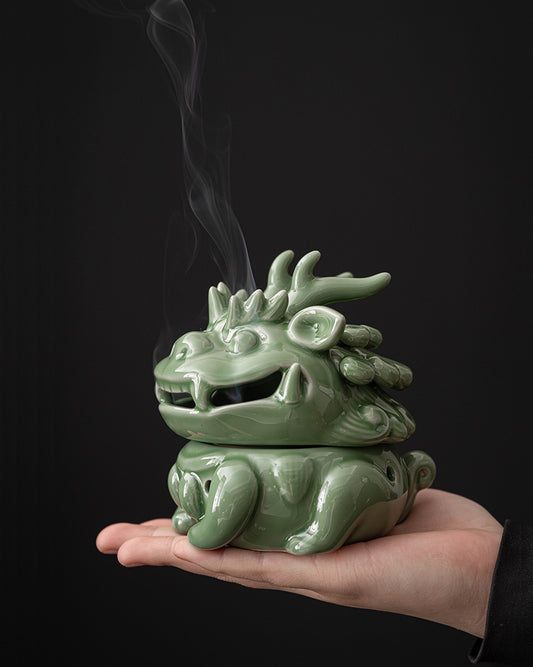
Earth is manifested in two forms during the ritual. Firstly, it is the ceramic censer, born from clay and shaped by human hands, providing a grounded sanctuary for the ceremony. Secondly, it is the meticulously sifted ash that fills the censer. This ash is pressed and shaped into a pristine, mountain-like peak or a perfectly flat plain. The ash insulates the heat and holds the structure of the ritual. It represents the quiet, foundational support of the earth, absorbing and nurturing without claiming attention.
Gold or Metal (Jīn): The Precision of the Mind
The instruments used to manipulate the ash and place the incense—the spatulas, tampers, chopsticks, and feather sweeps—are traditionally forged from brass, copper, or silver. Metal represents clarity, precision, and focus. The cold, unyielding nature of the metal tools stands in elegant contrast to the warm, ephemeral nature of the scent. Handling these tools requires a steady hand and a serene mind, enforcing the discipline that separates casual burning from the true Incense Tao.
Fire (Huǒ): The Hidden Catalyst
In Xiangdao, fire is never permitted to rage. A small piece of specialized charcoal is ignited until it glows white-hot, then carefully buried deep within the mound of ash. This hidden ember represents the element of Fire—restrained, invisible, yet possessing the transformative power to unlock the essence of the wood. It symbolizes internal vitality and the gentle alchemy that turns the physical into the spiritual.
Water (Shuǐ): The Flow of Qi
Though water is not physically present in the censer, it is the elemental metaphor for the smoke and the fragrance itself. In classical Chinese poetry, the movement of scent is often described as a flowing river or a rising mist. The invisible aroma behaves like water, flowing through the air, permeating boundaries, and purifying the spiritual atmosphere. It represents the smooth flow of Qi (life energy), washing over the observer and cleansing the turbulence of the mind.
Today, the Five Elements can also inspire a more accessible everyday incense ritual. If you are curious about exploring this modern interpretation, see our guide to Five Element incense and Chinese incense traditions.

Five Element incense and Chinese incense traditions
The Classical Aesthetics of the Ritual
To engage in the Incense Tao is to step outside the relentless march of modern time. The ritual demands preparation. The practitioner sits with a straight spine, breathing deeply to calm the spirit before touching the tools. The pressing of the ash must be smooth and flawless, an exercise in mindfulness. Whether one is creating a "Zhuanxiang" (an intricate incense seal formed of powdered wood) or performing "Gehuoxunxiang" (heating a singular sliver of agarwood over a mica plate), the process is deliberate and unhurried. The instruments used to manipulate the ash and place the incense—the spatulas, tampers, chopsticks, and feather sweeps—form part of a traditional Chinese incense toolkit.
Classical literature often speaks of the "fragrant companion." Su Dongpo, a revered poet of the Song Dynasty, wrote intimately of sitting alone in his study, watching a single thread of incense smoke rise straight into the quiet air, acting as a silent confidant. The aesthetic is one of "Liu Bai(留白)" and "Qingkeng" (cool elegance)—a deeply introverted beauty that does not seek to dazzle the eye, but to resonate with the soul.
For a closer look at how the vessel interacts with its surroundings, explore our guide to incense holder placement and Feng Shui.
A Vessel of Time and Inheritance
The materials and implements of Xiangdao are far more than mere consumer goods; they are artifacts of high cultural lineage and profound spiritual significance. A well-crafted censer, a set of hand-forged brass tools, or a small vial of aged agarwood are items of significant collectible value. They are heirlooms that carry the patina of time and the accumulated tranquility of countless ceremonies. As the years pass, the ceramic absorbs the lingering notes of the incense, and the brass tools soften under the touch of the practitioner, becoming intimately bound to their owner.
In an era defined by instantaneous gratification, investing in the tools and materials of the Incense Tao is a commitment to a different rhythm of life. It is an acquisition of patience, a physical repository for one's spiritual cultivation. These pieces do not depreciate; they mature, just as the practitioner’s understanding of the Tao deepens with every inhalation.
Cultivating the Self in a Fleeting World
Ultimately, understanding what is Xiangdao incense tao requires looking inward. The fragrance eventually dissipates, the ash cools, and the smoke vanishes into the ether. Yet, the stillness achieved during the ceremony remains. Xiangdao is the art of capturing the ephemeral and allowing it to anchor the soul. It invites the international connoisseur to embrace a sophisticated, elevated mode of living—one where true luxury is found not in abundance, but in the perfect, quiet resonance of a single, masterful scent.